

 Share
SharePlayground Surfacing Compared: 5 Options Reviewed
Choosing playground surfacing is the decision that most often separates a playground that lasts a decade from one that generates complaints in its first year. The equipment usually arrives as specified. The surfacing is where value engineering bites, where climate does its damage, and where the difference between a compliant installation and a non-compliant one is invisible to the untrained eye. This article compares the five surfacing families used in practice: wet-pour EPDM, rubber tiles, artificial grass, engineered wood fiber and loose fill sand or gravel.
TNTY Group has designed, supplied and installed play areas and safety flooring since 2017, from offices in Ho Chi Minh City and Solna, Sweden. We have laid surfacing in some of the most demanding conditions in Vietnam: high-traffic airport terminals at Tan Son Nhat, Noi Bai, Da Nang, Cam Ranh, Phu Quoc International and Cat Bi in Hai Phong, coastal resort environments including NovaWorld Phan Thiet, and public parks such as Hoa Thuan Dong Ward Park in Da Nang. The comparison below reflects what we have seen perform and what we have seen fail.
For the wider scheme context, read this alongside our complete guide to outdoor playground equipment in Vietnam.
The four things surfacing has to do
Before comparing products, be clear about the functions the surface performs. Every trade-off below is a trade-off between these four.
- Impact attenuation. Reducing the severity of a head injury from a fall. In Europe this is tested to EN 1177, which establishes the Critical Fall Height of a surface system. In the US it is ASTM F1292, with pass limits of HIC 1000 and g-max 200. A surface has no single universal rating: it has a tested performance at a stated thickness and system build-up.
- Accessibility. Whether a wheelchair, a walking frame or a pushchair can traverse the surface. ASTM F1951 addresses accessibility of surface systems, and ADA principles apply where referenced.
- Durability and maintainability. Resistance to ultraviolet exposure, heavy rainfall, standing water, heat, wear at pinch points, and vandalism, together with the labour required to keep it serviceable.
- Cost over life. Capital cost plus maintenance plus replacement cycle. The cheapest surface to install is very rarely the cheapest to own.
Two rules follow from this and they resolve most arguments. First, the required Critical Fall Height comes from the equipment, specifically the free height of fall of the highest accessible standing or sitting surface, so specify the equipment before the surfacing. Second, a surface only performs as tested when installed with the tested build-up: base course, drainage, thickness and layer composition. A wet-pour system laid thin over an inadequate base is not the product that was tested.
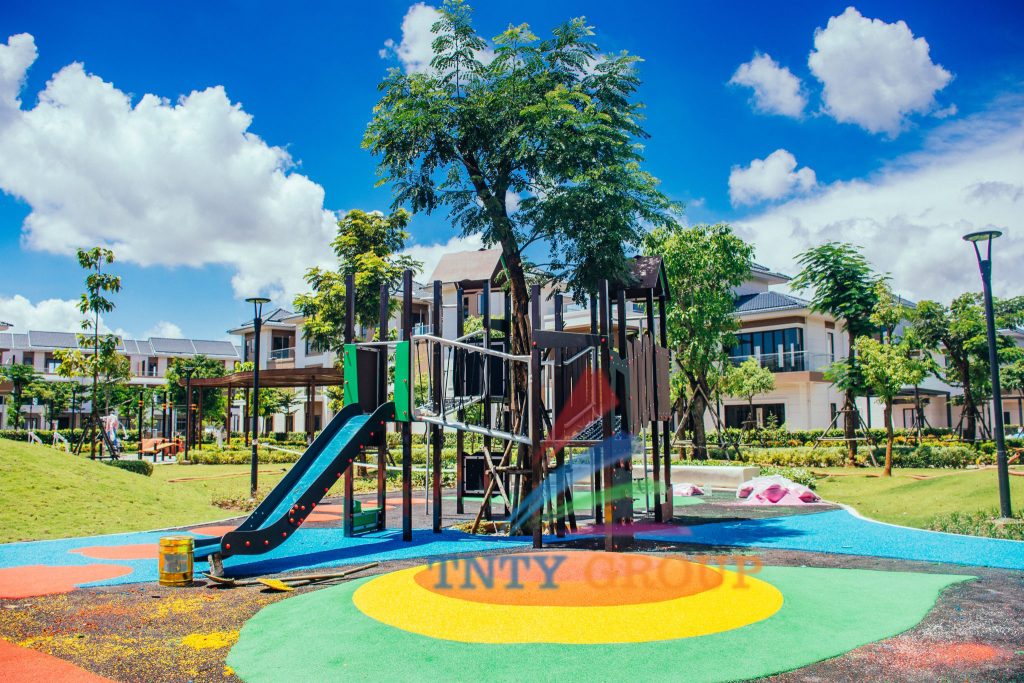
Wet-pour EPDM
A poured-in-place system: a shock-absorbing base layer of recycled rubber granule bound with polyurethane, topped with a wearing layer of coloured EPDM granule. It cures in situ into a seamless, permeable sheet.
Strengths. Seamless, so no joints to lift or trip on. Fully formable to curves, mounds, circles and graphic inlays, which makes it the default for design-led schemes. Excellent accessibility. Impact performance tuned by increasing base layer thickness, so a single system can serve fall heights from low to high. Permeable, which matters greatly in monsoon rainfall. Long service life when correctly installed.
Weaknesses. It is a wet trade installed on site, so quality depends heavily on the installer, the weather window and the base. Poor mixing, wrong binder ratio, contamination or laying on a damp or dusty base produce granule loss and delamination. Repairs are visible unless done well. Dark colours get hot in direct tropical sun. Not the cheapest option at installation.
Specify carefully. Granule quality is the main hidden variable: virgin EPDM with a stated polymer content behaves very differently from cheap filler-heavy granule that fades and powders. REACH is the relevant reference point for granule chemistry, and EN 71-3 for migration of certain elements. Our EPDM rubber flooring guide covers the build-up, granule grading, thickness against fall height and Vietnamese climate factors in depth.
Rubber tiles
Factory-made interlocking or bonded tiles of moulded rubber, typically with a denser wearing face over a shock-absorbing body, laid on a prepared base or on a bound sub-base.
Strengths. Factory-controlled thickness and density, so impact performance is consistent and does not depend on site workmanship in the same way as wet-pour. Fast to install, and installable in weather that would stop a poured system. Individual tiles can be lifted and replaced, which makes local repair genuinely easy. Good for retrofit onto existing hard surfaces and for areas where a single item of equipment needs protection.
Weaknesses. Joints. Every joint is a potential entry for water, dirt and plant growth, and a potential lifting or curling point if the base moves or if the tiles were not properly bonded and edge-restrained. Curved and organic shapes require cutting, which increases waste and joint length. Colour and pattern flexibility is more limited than wet-pour.
Specify carefully. Base preparation and edge restraint are the make-or-break items. Tiles laid on an unbound, uneven base will telegraph every defect and will eventually move.
Artificial grass with shock pad
Synthetic turf, usually with a sand or rubber infill, laid over a separate shock-absorbing pad where impact attenuation is required.
Strengths. Natural appearance, popular in resorts, hotels, residential landscapes and school grounds. Comfortable and cool underfoot relative to dark rubber if a suitable pile and infill are chosen. Impact performance is set by the shock pad rather than the turf, so the system can be tuned. Works well for large open areas and for zones combining play with informal ball games. EN 14877 is the reference standard for synthetic surfaces for outdoor sports areas where a sports use is included.
Weaknesses. The turf is a wearing item, and it wears fastest exactly where play concentrates: under swings, at slide exits, on desire lines. Infill migrates and needs redistribution. Without a shock pad, artificial grass provides very little impact attenuation, and installing it under high equipment without one is a common and serious specification error. Seams can open. Drainage depends on the pad and base as much as on the turf backing. Hygiene needs attention in high-use areas.
Specify carefully. Insist on the shock pad as a named, tested component with the system’s Critical Fall Height stated for the combined build-up, not for the turf alone.
Engineered wood fiber
Processed wood fiber, produced to a specification, installed to a stated depth over a drainage layer and contained by edging. ASTM F2075 is the reference specification for engineered wood fiber, distinguishing it from ordinary mulch or bark chip.
Strengths. Natural appearance that suits woodland and nature-play schemes. Genuinely good impact attenuation at adequate depth, including at higher fall heights. When correctly graded, compacted and maintained, it can meet accessibility criteria under ASTM F1951, which distinguishes it from other loose fill materials. Lower installed cost than bound rubber systems.
Weaknesses. It is a loose material, so depth is the whole safety argument, and depth migrates. It displaces at slide exits and under swings, compacts over time, decomposes, and needs topping up and raking as an ongoing operational commitment. In heavy monsoon rainfall, drainage beneath it must be excellent or it becomes waterlogged and breaks down faster. Accessibility performance depends on continued maintenance. It can conceal foreign objects and it attracts scattering.
Specify carefully. Do not accept generic bark mulch supplied as engineered wood fiber. Require the material specification, the installed and settled depth, the drainage layer, the edge containment and a written topping-up regime.
Loose fill sand and gravel
Washed, graded sand or rounded pea gravel installed to depth over a drainage layer with edge containment.
Strengths. Lowest capital cost of the bound and unbound options. Sand has real play value in its own right for digging and moulding, especially for younger children, and is well suited to beach-adjacent resort schemes. Both drain well when correctly graded. Simple to install with local labour and simple to top up.
Weaknesses. Poor accessibility: a wheelchair cannot cross deep loose fill, so a sand or gravel playground is effectively unavailable to some users unless accessible routes and transfer points are added in another material. Migration and displacement are constant. Sand tracks into buildings, holds moisture, and can harbour contamination, litter and animal waste, so it requires regular sifting, raking and periodic replacement. It compacts and, when wet then dried, can lose attenuation performance. Gravel migrates onto paths and becomes a slip and projectile hazard.
Specify carefully. If loose fill is chosen for cost reasons, budget honestly for the labour to maintain it and provide a bound accessible route and accessible activity zone alongside it.
The comparison table
| Criterion | Wet-pour EPDM | Rubber tiles | Artificial grass with shock pad | Engineered wood fiber | Loose fill sand or gravel |
|---|---|---|---|---|---|
| System type | Bound, poured in situ, seamless | Bound, factory moulded units | Bound turf over separate shock pad | Unbound loose fill to ASTM F2075 | Unbound loose fill |
| Impact attenuation control | Base layer thickness, tuned per fall height | Tile thickness and density, factory set | Shock pad thickness, turf contributes little | Installed and maintained depth | Installed and maintained depth |
| Test reference | EN 1177, ASTM F1292 (HIC 1000, g-max 200) | EN 1177, ASTM F1292 | EN 1177, ASTM F1292, EN 14877 for sports use | EN 1177, ASTM F1292, ASTM F2075 | EN 1177, ASTM F1292 |
| Accessibility (ASTM F1951 / ADA) | Excellent | Very good, subject to flush joints | Good | Achievable only with active maintenance | Poor |
| Design and colour freedom | Highest: curves, mounds, graphics, inlays | Moderate: modular colours and patterns | Limited: turf tones, inlaid lines possible | Natural appearance only | Natural appearance only |
| Installation sensitivity | High: wet trade, weather and workmanship critical | Low to moderate: base and edge restraint critical | Moderate: base, pad and seaming critical | Low: depth and drainage critical | Low: depth and containment critical |
| Drainage behaviour | Permeable through the system | Through joints and base, joints can clog | Through backing, pad and base | Very good if drainage layer is correct | Very good if correctly graded |
| Tropical and monsoon performance | Strong, dark colours get hot | Strong, watch joint water ingress | Strong, infill migration in heavy rain | Waterlogging and decomposition risk | Sand holds moisture, gravel migrates |
| Wear at high-traffic points | Localised granule loss, repairable | Individual tiles replaceable | Turf flattening and bald patches | Rapid displacement at slide and swing | Rapid displacement at slide and swing |
| Routine maintenance | Sweeping, wash down, patch repair | Sweeping, joint cleaning, tile swap | Brushing, infill top-up, sanitising | Raking, depth check, topping up | Sifting, raking, topping up, replacement |
| Ease of local repair | Possible, colour match can show | Easiest: lift and replace a tile | Patch or panel replacement, seams show | Very easy: add material | Very easy: add material |
| Relative capital cost | Higher | Moderate to higher | Moderate | Lower | Lowest |
| Relative maintenance burden | Low | Low to moderate | Moderate | High and continuous | Highest and continuous |
| Vandalism resistance | Good, cuts and burns possible | Good, tiles can be prised up if unbonded | Moderate, cuts and burns show | Poor, scatterable | Poor, scatterable and throwable |
| Best fit | Airports, malls, urban parks, design-led schemes | Retrofits, phased works, single-item fall zones | Resorts, schools, residential landscape, mixed play and ball | Nature play, woodland settings, larger budgets for upkeep | Sand play zones, beach resorts, low-budget with staffed upkeep |
| Main failure mode to guard against | Thin base layer or poor bonding to substrate | Lifting joints on an inadequate base | Omitting the shock pad entirely | Depth loss and decomposition | Depth loss and contamination |
How to choose in practice
A workable decision sequence:
- Fix the equipment and its free height of fall. This sets the required Critical Fall Height and therefore the minimum system build-up. See our guide to playground safety standards for how EN 1176 and ASTM F1487 define fall heights and use zones.
- Set the accessibility requirement. If a genuinely inclusive playground is the goal, bound systems should carry the primary circulation and the main activity zones. Loose fill can supplement but should not be the only surface.
- Test the maintenance reality. Ask honestly whether the operator will rake and top up loose fill weekly for ten years. If not, do not specify loose fill as the primary safety surface.
- Assess the climate exposure. Rainfall intensity, standing water risk, ultraviolet exposure, coastal salt and surface temperature in direct sun.
- Consider phasing and repairability. Where the site will be worked on in stages or where local repair capability is limited, tiles have a real advantage.
- Compare lifecycle, not capital. Add maintenance labour, materials and expected replacement cycle to the installed cost. This frequently reverses the apparent ranking. The method is set out in playground project cost drivers.
Mixed solutions are normal and often correct: wet-pour under the main structure and along accessible routes, artificial grass across open informal areas, a contained sand play zone for younger children, tiles under a retrofitted item. What matters is that each zone’s surface is correct for the fall height above it.
Getting the specification and the handover right
Whatever family you choose, your tender should require the tested system build-up rather than a product name, the Critical Fall Height for that build-up, the base and drainage design, edge restraint details, the installer’s method statement and weather constraints, and the maintenance regime with materials and frequencies. At handover, obtain the test documentation, as-built layer thicknesses, and a maintenance schedule you can put straight into an inspection routine. Our maintenance and inspection checklist shows how surfacing checks fit into the routine, operational and annual inspection tiers.
Indoor projects follow much of the same logic with different weighting toward cleanability and acoustics, which we cover in our indoor playground design guide. The full range of flooring lines we supply, including Green Floor and TNTY Floor, along with partner surfacing brands such as Robertson Recreational Surfaces and Sports Surface Specialties, is on our products page.
Frequently asked questions
Which playground surfacing is safest?
No family is inherently safest. Safety comes from matching the tested Critical Fall Height of the installed system to the free height of fall of the equipment above it, under EN 1177 or ASTM F1292 with pass limits of HIC 1000 and g-max 200. A thick engineered wood fiber layer, correctly maintained, can outperform a thin wet-pour system. Depth and build-up decide the outcome, not the material category.
Does artificial grass need a shock pad under play equipment?
Yes, wherever impact attenuation is required. Turf alone provides very little attenuation. The Critical Fall Height belongs to the combined system of turf, infill, shock pad and base, and that combined build-up is what must be tested and documented. Installing turf without a pad under elevated equipment is one of the most common serious specification errors we encounter.
How does Vietnam’s climate affect the choice?
Intense ultraviolet exposure, high humidity, coastal salt and heavy monsoon rainfall all matter. Permeable bound systems and good sub-base drainage cope well. Loose fill needs excellent drainage or it waterlogs and decomposes. Dark rubber gets hot in direct sun, so shade and lighter colours help. Coastal sites also need attention to the corrosion protection of edgings, drainage components and equipment fixings.
Can I mix different surfacing types in one playground?
Yes, and it is often the best answer. A typical scheme uses bound surfacing for accessible routes and the main structure fall zones, artificial grass across informal open areas, and a contained sand zone for sensory and construction play. The requirement is that each zone’s surface meets the fall height of the equipment above it and that accessible routes remain continuous.
Which surfacing is cheapest over the whole life of the playground?
We will not publish figures we cannot substantiate, but the structural pattern is consistent: loose fill options have the lowest capital cost and the highest ongoing labour and replacement burden, while bound rubber systems have a higher capital cost and a much lower maintenance burden. Where the operator has limited maintenance resource, bound systems usually win over the life of the asset. Build the comparison with your own local labour and material rates.
How do I verify that the surfacing installed is what I paid for?
Require documentation of the tested system and its Critical Fall Height before installation, witness and record layer thicknesses during the works rather than after, take photographs of the base and each layer, and obtain as-built records at handover. Once a bound system has cured or a loose fill has been spread, verifying thickness becomes far harder and more disruptive.
Get an independent view on your surfacing choice
Surfacing is the part of a playground where specification detail matters most and where it is hardest for a buyer to verify what has been delivered. TNTY Group offers a free site survey and consultation: we will assess your equipment fall heights, drainage and exposure conditions, recommend a surfacing strategy zone by zone, and write a specification that names the tested build-up rather than a marketing product name. Contact us via our contact page, call our Ho Chi Minh City office on 84 28 66 89 8888 or the hotline on 84 937 501 501, or reach our Solna office in Sweden on 46 842 002 688. You can also see delivered examples in our projects.