

 Share
ShareOutdoor Playground Equipment Guide for Vietnam
Specifying outdoor playground equipment looks simple from the outside. You pick a colourful structure from a catalogue, pour some rubber under it, and cut a ribbon. In practice a playground is public infrastructure that has to survive tropical rain, salt air, UV, thousands of small bodies per week and an inspection regime that will outlive the project manager who bought it. The decisions that determine whether the space is still safe and still popular in year eight are almost all made in the first three weeks, on paper, before anything is manufactured.
This guide is written for the people who sign off those decisions: residential developers, park and ward authorities, schools, resort and airport operators, and family entertainment centre owners. It covers equipment categories, how age grouping drives layout, which safety standards to write into a tender, how surfacing and fall height interact, and what a competent procurement and handover process looks like. TNTY Construction Company has delivered play and sports surfacing projects since 2017 from offices in Ho Chi Minh City and Solna, Sweden. Each section links to a deeper article where the detail deserves its own treatment.
Start with users, not with catalogues
The most common specification error is buying a structure before defining who plays on it. Equipment is certified for age bands, and mixing bands on one structure creates safety and usability problems: a toddler who climbs onto a platform meant for a nine year old is exposed to a fall height the toddler surfacing was never designed for.
Before any product selection, write down four things:
- Age bands served. Typically under 2, 2 to 5, and 5 to 12, with a separate teen offer if the site justifies it.
- Peak concurrent users. A residential podium at 6pm behaves nothing like a school yard at break time.
- Supervision model. Parents seated with sightlines, teachers patrolling, or unsupervised public access. This drives sightlines, fencing and acceptable challenge.
- Inclusion requirement. Whether the brief demands ground level play and accessible routes, which affects layout and surfacing.
If your brief includes children with disabilities, read the guide to inclusive and accessible playground design before fixing the layout. Retrofitting accessible routes into a finished plan is expensive and usually compromised.
Equipment categories and what each one buys you
Play value is not proportional to steel tonnage. A well chosen mix of five or six play types will out-perform one enormous multi-play unit that eats the whole budget.
Multi-play structures
Towers, decks, bridges, slides and climbing attachments in one unit. These anchor most playgrounds because they concentrate many play types into a compact footprint. Watch platform heights: every increase raises the free height of fall and therefore the surfacing specification underneath.
Swings
Still the highest demand item and the most demanding on space, because a swing needs generous clearance in the direction of motion. Options include flat seats, toddler cradles, inclusive seats with back and harness support, and nest swings that let a child and carer swing together.
Climbing and net structures
Rope courses, nets, boulders and climbing walls deliver high play value per square metre and scale challenge naturally, since a child stops where their ability stops. They need careful attention to entrapment gaps and to fall zone geometry around the whole structure, not just below it.
Rotating and rocking play
Carousels, spinners, seesaws and springers cover vestibular play that structures alone do not provide. Rotating equipment has specific clearance requirements and should never sit on a slope or against a hard edge.
Sensory, musical and imaginative play
Outdoor instruments, sand and water tables, panels and playhouses serve younger children and those who do not want gross motor challenge. They are also the cheapest way to raise dwell time. TNTY carries TNTY Music for outdoor instruments and Green Play and Uni Play for themed and natural play, alongside TNTY Play, Max Play and Ceria. See the products page.
Shade, shelter and site furniture
In Vietnam this is a functional requirement, not an accessory. Unshaded metal and dark surfacing get hot, and an unshaded playground empties between 11am and 3pm. Shade, seating, bins, drinking points and bike parking turn a play area into a place families stay. TNTY works with Porter Corp, Icon Shelter Systems, Frog Furnishings and Dero here.
Water play and outdoor fitness
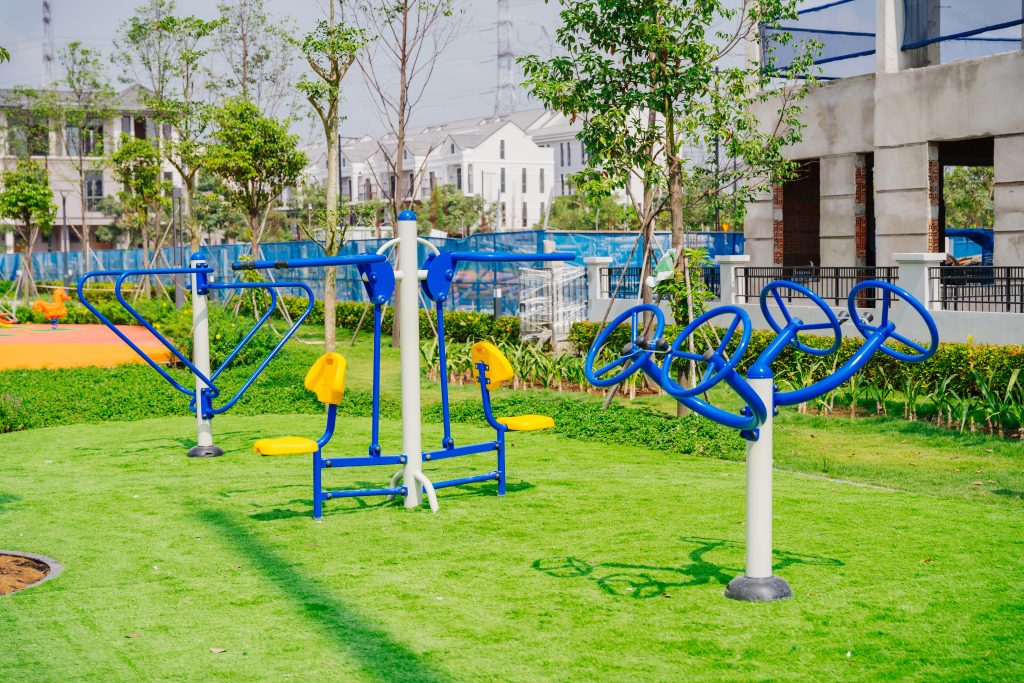
Splash pads are the highest impact addition in a hot climate and a different engineering discipline, involving filtration, recirculation or flow-through decisions, controls and slip resistance. Treat water as its own workstream and start with the guide to splash pad and water playground design. Adult and youth fitness equipment beside a play area turns a children’s playground into a family destination for very little space; corrosion is the dominant durability issue, covered in the outdoor fitness equipment guide.
Safety standards: what to write into the tender
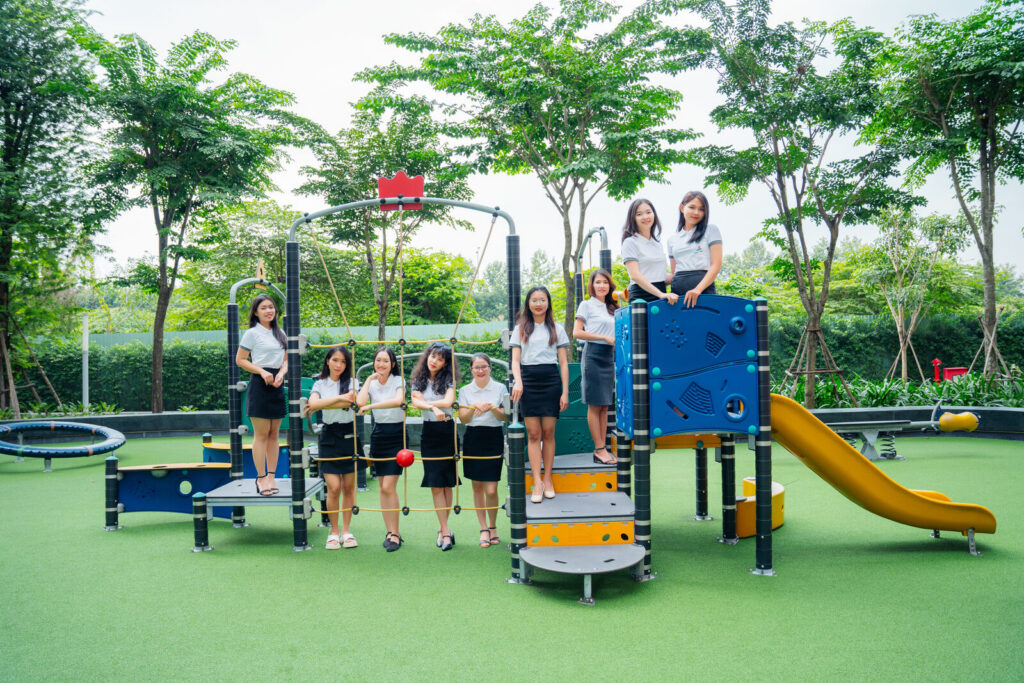
Equipment safety is not a matter of opinion, and a supplier who cannot name the standard their product is built to should not be on your shortlist.
| Standard | Scope | Why it matters to you |
|---|---|---|
| EN 1176 | Playground equipment, general and equipment specific parts | Entrapment, fall height, clearance zones, structural integrity, installation, inspection |
| EN 1177 | Impact attenuating playground surfacing | Defines the Critical Fall Height test your surfacing must be certified to |
| ASTM F1487 | Public use playground equipment | US equivalent scope to EN 1176, used by many international operators |
| ASTM F1292 | Impact attenuation of surfacing systems | Pass limits are HIC 1000 and g-max 200 at the stated fall height |
| ASTM F1951 | Accessibility of playground surface systems | Required where an accessible route crosses the safety surface |
| ASTM F2075 | Engineered wood fiber | Specifies the loose fill material if you choose EWF |
| CPSC Handbook | US public playground safety guidance | Practical layout and hazard guidance, often cited alongside ASTM |
| TCVN | Vietnamese national standards | Applicable TCVN requirements should be confirmed for the project and authority |
Do not write “must be safe”. Write the standard, the part number, and require accredited test reports naming the product tested. The detailed comparison of what each framework controls, plus the entrapment and fall zone basics you can check on site, is in the article on playground safety standards.
Surfacing is half the safety case
Certified equipment over the wrong surface is an unsafe playground. Surfacing is selected from the highest free height of fall on site, and the certified Critical Fall Height must equal or exceed it, with the whole impact area covered, not just the patch under the slide exit.
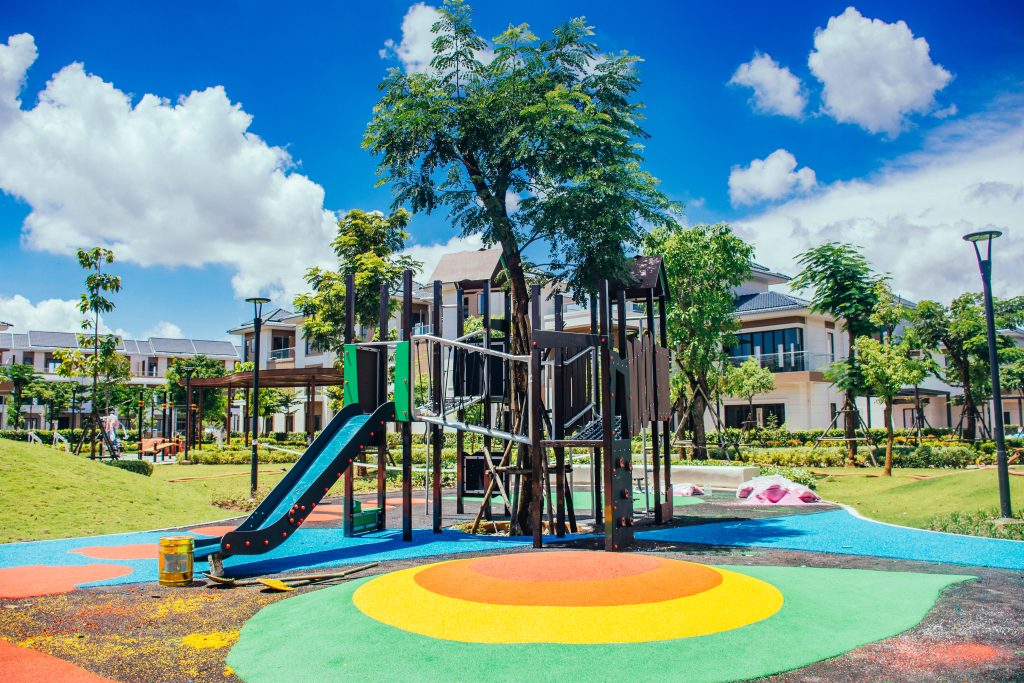
The realistic options are wet-pour EPDM, rubber tiles, artificial grass with a shock pad, engineered wood fibre and loose fill sand or gravel. Each trades initial cost against maintenance, accessibility and heat. Wet-pour EPDM is the default for permanent public installations because it is seamless, accessible and can be built to a specific fall height: see the EPDM rubber flooring guide. For a side by side view of every option, read the playground surfacing comparison. TNTY supplies surfacing through Green Floor and TNTY Floor with partners including Robertson Recreational Surfaces and Sports Surface Specialties.
Site planning: the constraints that decide your layout
Most layout problems are site problems in disguise. Before drawing, resolve these:
- Drainage. Falls, gullies and outlets. A permeable surface over a subbase that does not drain holds water, grows algae and fails early. This is the leading cause of premature surfacing failure in Vietnam.
- Subbase. Existing concrete, new concrete or compacted aggregate. This governs surfacing options and foundation design.
- Sun path and shade. Put the toddler zone and seating in shade. Avoid orienting a metal slide at the afternoon sun.
- Clearance and free space zones. Dimensional requirements from the standards, not suggestions, and they overlap badly if you place equipment by eye.
- Access and circulation. An accessible route from the entrance to ground level play, plus maintenance access.
- Services. Water, drainage capacity and power for water play or lighting, plus conflicts with buried services.
- Boundaries. Fencing, gates and separation from traffic, car parks and water bodies.
Where an indoor component is in the same brief, the planning logic changes: throughput, ceiling height, fire and hygiene take over. That is covered in the indoor playground design guide.
Budgeting without pretending you know the price
Equipment is rarely the largest line. Groundworks, drainage, surfacing area, shade, furniture, transport and installation access frequently add up to more than the play units. Budgets built on an equipment quote alone are why so many playgrounds are value engineered into disappointment late in the process.
Think in cost drivers: total surfaced area and its required fall height, number of distinct fall heights, subbase condition, water play complexity, shade coverage, and site access for delivery. Then compare capital against lifecycle cost, because a cheaper surface needing annual topping up is not a saving. Tender traps and value engineering options are set out in playground project cost drivers.
Procurement, installation and handover
A defensible process has five stages. Skipping any of them shows up later as a defect or an argument.
- Survey and brief. Site measurement, drainage and subbase assessment, user definition. TNTY provides a free site survey at this stage.
- Concept and technical design. Layout with clearance zones proven, fall heights scheduled against surfacing specification, drainage strategy, shade.
- Specification and supply. Data sheets, compliance evidence, colour approval, delivery sequencing.
- Installation. Foundations, assembly and surfacing by trained crews. EN 1176 treats correct installation as part of compliance, so a certified product wrongly installed is not compliant.
- Inspection and handover. Inspection before opening, as built documentation, manuals, the maintenance regime, and a spare parts list.
Ask for the handover pack in the tender, not at the end. The maintenance regime preserves both your investment and your legal position: routine visual checks, operational inspections and an annual main inspection, with records. That structure is in the playground maintenance and inspection checklist, and TNTY’s delivery sequence is described under our process.
What experience on real sites teaches
Projects across airports, master planned communities and public parks converge on the same lessons. Shade is never regretted. Drainage is always cheaper to solve before the surface goes down. Toddler zones need separated space or they get overrun. And the equipment used most is often the least photogenic: swings, sand, spinners and instruments.
TNTY’s reference projects include play and surfacing work at Tan Son Nhat, Noi Bai, Da Nang, Cam Ranh, Phu Quoc International and Cat Bi airports, plus NovaWorld Phan Thiet, Dai Phuoc Lotus Zone 4, GS Metro City, Hoa Thuan Dong Ward Park in Da Nang and COCO KIDS CLUB & CAFE in Ben Tre. Browse them on our projects.
Frequently asked questions
How much space do I need for an outdoor playground?
There is no single figure, because the driver is not equipment footprint but the clearance and free space zones around each item plus the impact area that must be surfaced. Swings and rotating equipment need the most. Plan the surfaced impact area first and treat the equipment as sitting inside it, rather than adding a border at the end.
Which standard should I specify, EN or ASTM?
Either is defensible provided you specify it consistently and require test evidence, and you should confirm applicable TCVN requirements with the relevant authority. Pick one primary framework and its matching surfacing standard, so EN 1176 with EN 1177, or ASTM F1487 with ASTM F1292. Mixing halves of two frameworks creates gaps.
What is most durable on coastal and tropical sites?
Corrosion protection and UV stability decide this: hot dip galvanised and properly powder coated steel, marine grade stainless fixings, HDPE panels rather than painted timber, and UV stable colour in surfacing granules. Ask what the coating system and fixing material are, because that is where cheap equipment saves money.
Can water play be added to an existing playground?
Often yes, but it depends on water supply, drainage capacity, power and space for a plant enclosure if recirculation is used. The choice between flow-through and recirculation determines cost and operating complexity, so resolve it before designing the feature layout.
How long does a playground project take?
The variable is rarely manufacturing. It is design approval, groundworks and weather. Surfacing needs dry conditions and a cured, correctly drained base, so wet season programmes should build in float. Early decisions on drainage and fall heights compress the programme more than anything else.
What documentation should I insist on at handover?
As built drawings, data sheets, compliance evidence including surfacing test results at the relevant fall height, assembly and maintenance manuals, the recommended inspection schedule, and a spare parts list with part numbers. Without these your annual inspection has no baseline.
Next step
If you are planning an outdoor playground, water play area or sports surfacing project, get the site assessed before the design is locked. TNTY offers a free site survey and consultation covering drainage, subbase, layout options, fall heights and surfacing recommendations, from offices in Ho Chi Minh City and Solna. Learn more about us or get in touch through the contact page, tel 84 28 66 89 8888, hotline 84 937 501 501, email [email protected].