

 Share
ShareWater Playground Design: Splash Pad Guide
In a climate like Vietnam’s, water is the single highest impact addition you can make to a play area. A splash pad turns a twenty minute visit into a two hour one, extends the usable part of the day well past the point where dry equipment gets too hot, and gives a resort, township or public park an attraction that photographs itself. It is also the one play discipline where water playground design decisions made in week one determine your operating cost, your water bill and your compliance burden for the next decade.
The core of that is a single choice: flow-through or recirculation. Everything else, the plant room, the filtration, the treatment, the controls, the drainage and even the deck finish, follows from it. Get it right and you have a low drama attraction that runs on a timer. Get it wrong and you have either an unaffordable water bill or a treatment system nobody on site is qualified to operate.
This guide walks a buyer through the whole decision set: system type, water treatment, nozzle selection and zoning, deck and slip resistance, controls and activation, drainage, seasonal operation and maintenance. For the wider project context see the outdoor playground equipment guide.
Flow-through or recirculation: the decision that shapes everything
A flow-through splash pad takes potable water from the mains, sprays it, and sends it to waste or to irrigation. There is no plant room, no filtration, no chemical dosing and effectively no water treatment compliance burden, because the water is single pass. It is simple, cheap to build, and very expensive to run in water terms.
A recirculation splash pad collects the sprayed water in a below ground tank, filters it, treats it, and pumps it back to the nozzles. It uses a fraction of the water but adds a plant room, filtration, disinfection, monitoring and a trained operator, and it means the water is legally and practically closer to pool water than to a garden sprinkler.
| Factor | Flow-through | Recirculation |
|---|---|---|
| Water consumption | High, every litre sprayed is consumed | Low, top-up for evaporation, splash-out and backwash only |
| Capital cost | Lower, no plant room or tank | Higher, tank, pumps, filtration, dosing, controls |
| Operating cost | Dominated by water charges | Dominated by power, chemicals and labour |
| Water treatment duty | Minimal, single pass potable water | Substantial, filtration and disinfection with monitoring |
| Operator skill needed | Low | Trained operator with pool water knowledge |
| Space required | Deck and drainage only | Deck plus below ground tank and plant enclosure |
| Best suited to | Small features, low hours, cheap water, irrigation reuse | Large pads, long hours, high throughput, resorts and commercial venues |
| Risk profile | Cost overrun on water bills | Water quality failure if operation lapses |
The honest guidance: small features on a site with cheap water and somewhere useful to send the run-off, for example landscape irrigation, can justify flow-through. Anything of scale, anything running long daily hours, and anything in a commercial venue where the pad is a paid or reputational asset should be recirculating. The crossover comes faster than most clients expect, because water consumption scales with nozzle count and run hours, not with pad area.
Filtration and water treatment for recirculating systems
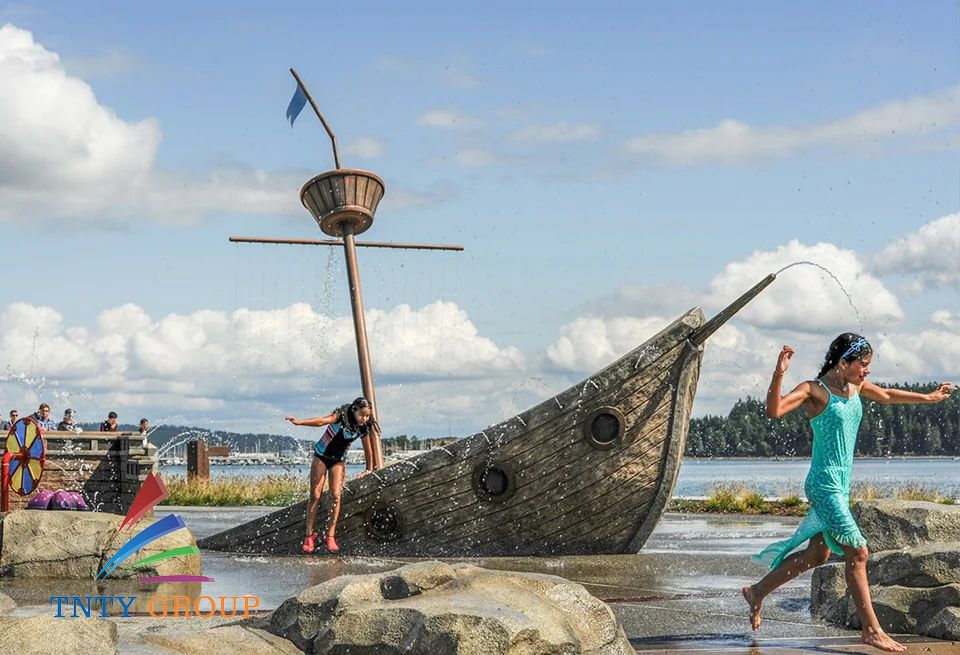
Splash pad water is harder to treat than pool water, and this surprises people. The reasons are structural: the bather load per litre of water in the system is extremely high, contact time is short, water is aerated and warmed as it sprays, and the users are overwhelmingly small children, which means a high load of organic contamination.
The consequence is that a recirculating splash pad needs a fast turnover and a robust disinfection strategy, not a scaled down pool system.
Balance tank
Sized to hold the water in circulation plus surge, sited below the deck, with access for cleaning. Undersizing the tank is a common design error that causes pump cycling and unstable chemistry.
Filtration
Typically sand or a cartridge or media filter appropriate to the flow rate, with strainers ahead of the pumps. Debris load on an outdoor pad is high: leaves, sand, hair, sunscreen. Pre-filtration and easy access for cleaning matter more here than on a pool.
Disinfection
Chlorine based primary disinfection with automated dosing and continuous monitoring of residual and pH is the base case. Because contact time is short and load is high, many designers add a secondary treatment stage, commonly UV, to address chlorine tolerant organisms. UV is a supplement to chlorination, not a replacement for it, since a residual is still needed in the water on the deck.
Monitoring and interlocks
Automated controllers measuring free chlorine and pH, with alarms and, ideally, an interlock that shuts the features down if water quality goes out of range. This is what protects an operator who is not a full time pool technician.
Water balance
pH, alkalinity and hardness still matter, both for disinfection efficiency and to avoid scaling nozzles and corroding stainless components. Aerated water loses carbon dioxide and pH drifts upward, so a splash pad needs more active pH management than a pool of the same volume.
Practical specification point: require the design turnover rate, the disinfection strategy including any secondary treatment, the monitoring and alarm arrangement, and an operator training handover. TNTY works with water play and aquatic partner brands including Water Odyssey, Fountain People, AquaWorx and Spectrum Aquatics, alongside the Aqua Play and Aqua Fitness product lines; see our brands.
Nozzle selection and zoning
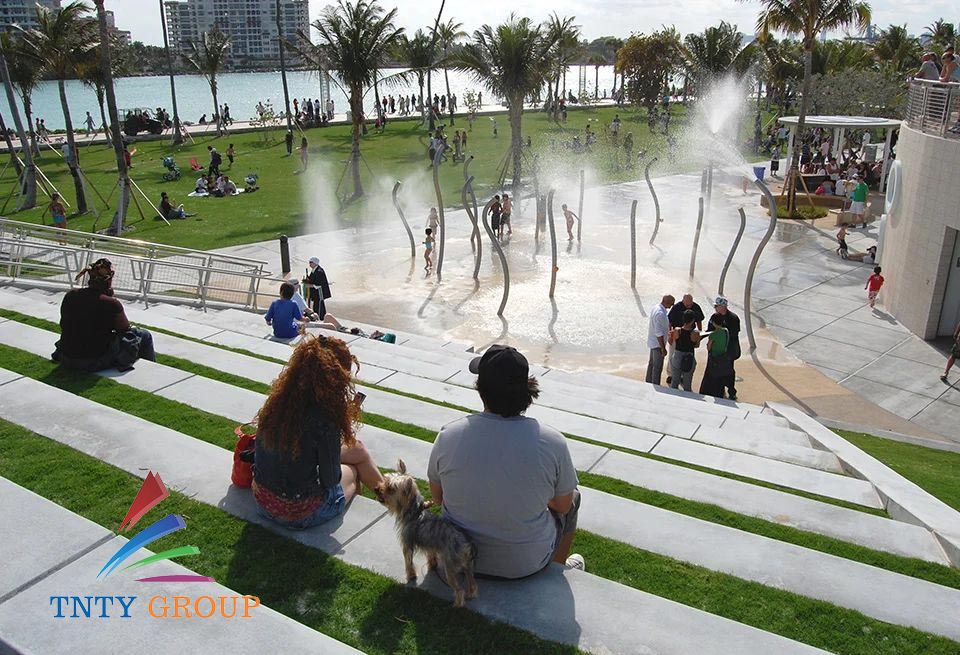
A splash pad is not a random field of jets. Good pads are zoned by age and by intensity, and the zoning is what makes them feel generous rather than chaotic.
- Toddler zone. Low, gentle, predictable water. Bubblers, low domes, small ground sprays, shallow film flow. No overhead dumping, no strong jets, no surprises. Place it where carers can sit in shade with clear sightlines, and ideally at the shallow, upstream end of the deck fall.
- Mid zone. Ground jets, arching sprays, spray hoops, interactive features that can be aimed or blocked. This is where most of the play value lives.
- High energy zone. Tipping buckets, dumping features, large above ground structures and water cannons. Loud, dramatic, and the anchor of the pad’s identity. Keep it away from the toddler zone, both physically and acoustically.
- Dry rest area. Shaded seating just off the wet deck. Families need somewhere to sit, and if you do not design it they will sit on the deck edge and block circulation.
Ground level versus above ground features
Ground level nozzles are flush, safe, visually quiet and let the pad double as a dry plaza when the water is off. Above ground features give the pad its silhouette and its marketing image, but they add fall height considerations, structural fixing, and maintenance access requirements. A balanced pad has plenty of the first and a small number of well chosen examples of the second.
Flow allocation
Every nozzle has a flow demand and a pressure requirement. Total demand drives pump and pipe sizing, and it is the reason nozzles are usually operated in sequenced groups rather than all at once. Sequencing lets you install more features than your flow could support simultaneously, which raises play value without raising plant size. It also makes the pad more interesting, because the water pattern changes.
Deck design, slip resistance and falls
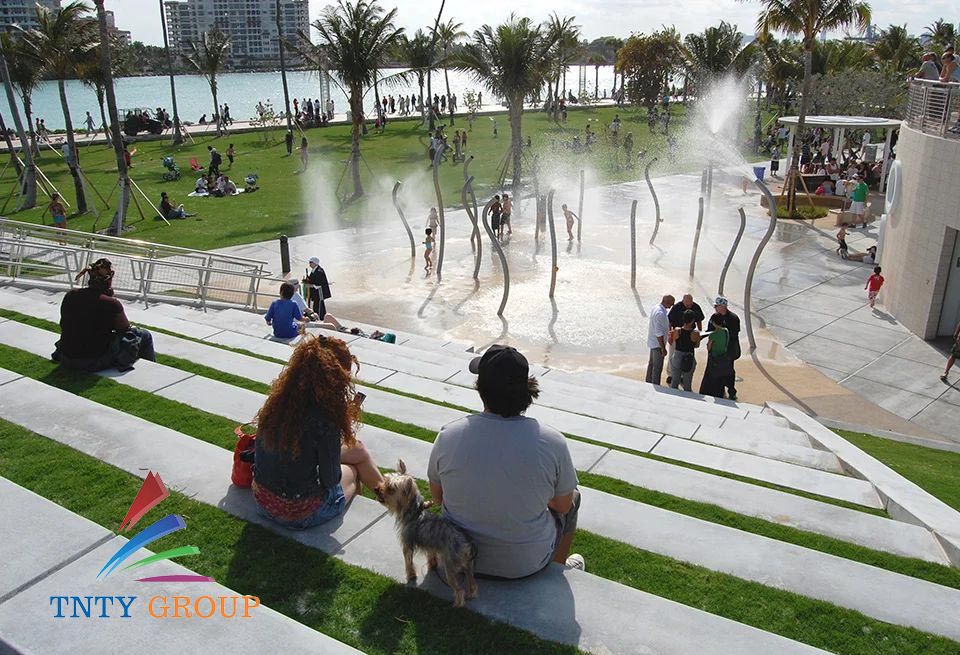
The deck is a wet, barefoot, high traffic, high UV surface used by running children. It has to be slip resistant when wet, comfortable underfoot in direct sun, drain positively and be able to be cleaned.
- Slip resistance. Specify a wet slip performance requirement for a barefoot area, not just a material. This applies whether you use textured concrete, tile or a poured rubber deck.
- Falls and drainage. Positive falls to drains, no ponding anywhere. Standing water is the origin of both slip incidents and biofilm. On recirculating systems the falls also have to reliably return water to the collection point.
- Surface temperature. Dark surfaces get hot. Lighter colours and shade over rest and toddler areas are functional requirements in Vietnam, not aesthetics.
- Edges and transitions. Flush transitions between the wet deck and surrounding surfacing, both for accessibility and to avoid trip hazards where a barefoot child is running.
- Cleanability. The deck will grow biofilm in shaded damp spots. It needs to be washable, and drainage grates need to be liftable for cleaning.
Where a poured rubber deck is used, particularly for the transition between splash pad and adjacent dry play, the system build-up and binder behaviour in humid conditions matter; see the EPDM rubber flooring guide. For comparison with other surface options around the wet zone, the playground surfacing comparison covers the alternatives.
Controls, activation and energy use
Controls are where a splash pad becomes cheap or expensive to run.
- User activation. A bollard or touch pad that starts a timed cycle. Water only runs when someone is playing, which cuts consumption and power dramatically compared with continuous operation.
- Sequencing. A controller cycles nozzle groups through patterns, spreading flow demand and keeping the play experience varied.
- Scheduling. Operating hours by day and season, with automatic shutdown outside them.
- Water quality interlock. On recirculating systems, features stop if chlorine or pH leaves the acceptable range.
- Variable speed pumps. Reduce energy consumption and allow flow tuning after commissioning, when you discover which features need adjusting.
- Manual override and isolation. Every feature should be isolatable so one broken nozzle does not close the pad.
Insist that the control philosophy is documented at handover, in plain language, with the operating parameters recorded. Controllers outlive the people who commissioned them.
Safety, supervision and layout
A splash pad has no standing water, which removes the drowning risk that governs pool design, but it introduces its own hazards.
- Slips. The dominant injury mechanism. Managed through slip resistance, drainage, and layout that discourages long straight running lines.
- Impact. Where above ground structures create a fall height, the relevant playground equipment and surfacing standards apply, meaning EN 1176 with EN 1177, or ASTM F1487 with ASTM F1292 where the pass limits are HIC 1000 and g-max 200. See playground safety standards.
- Water quality. The main public health risk on recirculating systems, addressed by treatment and monitoring rather than by design alone.
- Entrapment and suction. Collection points and drains must be designed so a child cannot be held against them, and grates must be secured against removal.
- Supervision. Sightlines from shaded seating across the whole pad, single obvious entry, and separation from vehicle circulation.
- Accessibility. Flush entry, an accessible route onto the deck, and ground level features usable by a child who cannot stand. Covered in inclusive and accessible playground design.
Applicable TCVN requirements and local health authority rules for water play should be confirmed for the project as part of design approval.
Seasonal operation and maintenance
In southern Vietnam a splash pad can run most of the year; in the north there is a genuine closed season, and there are heavy rain periods everywhere when it makes no sense to run the features.
- Daily. Visual check of every nozzle, clear debris from drains and strainers, check water quality readings on recirculating systems, walk the deck for ponding and damage.
- Weekly. Clean strainers and pre-filters, wash the deck, inspect above ground features and their fixings, check dosing chemical stock.
- Periodic. Backwash or clean filters per design, clean the balance tank, descale nozzles, service UV lamps and sensors, calibrate the controller probes.
- Season start. Full system flush and disinfection, calibration, nozzle by nozzle commissioning check, deck slip and drainage inspection, controller schedule reset.
- Season end. Drain lines that can freeze or stagnate, protect nozzles from debris ingress, secure the plant room, record outstanding defects while you remember them.
Fold this into a single site wide regime alongside the dry play equipment rather than running two parallel systems. The structure for that is in the playground maintenance and inspection checklist, and the way water play changes a project budget is discussed in playground project cost drivers.
Frequently asked questions
Do I need a plant room for a splash pad?
Only for a recirculating system, where you need space for pumps, filtration, dosing, the controller and safe chemical storage, plus a below ground balance tank. Flow-through systems need only a supply connection, a controller and drainage. Deciding this early matters because the tank and plant enclosure have to be designed into the site, not squeezed in later.
How much water does a splash pad use?
It depends on nozzle count, individual nozzle flow rates, sequencing and daily run hours, so it must be calculated for your specific design rather than estimated from area. The two biggest levers you control are user activation, so water runs only during play, and sequencing, so only some nozzles run at any moment. On a recirculating system, ongoing consumption is limited to evaporation, splash-out and filter backwash.
Can a splash pad be built over an existing plaza or car park?
Sometimes, but the constraints are drainage and, for recirculation, the below ground tank. Existing slabs rarely have the falls a wet deck needs, and cutting a tank into an existing structure is expensive. A survey of levels, drainage capacity, available water supply and power should come before any layout work.
Is UV enough on its own to treat splash pad water?
No. UV treats water as it passes through the unit but leaves no residual disinfectant in the water on the deck, and splash pad water has a very high contamination load with very short contact time. UV is valuable as a secondary treatment stage alongside chlorination with automated dosing and continuous monitoring, not as a replacement for it.
What is the biggest mistake in splash pad projects?
Choosing the system type on capital cost alone. A flow-through pad is cheaper to build and can be startlingly expensive to run; a recirculating pad is cheaper to run and needs an operator who understands water treatment. The right answer depends on your water cost, run hours and staffing, and it should be decided with an operating cost comparison in front of you.
How do I keep the deck from becoming slippery?
Specify a wet barefoot slip resistance requirement, design positive falls with no ponding anywhere, keep drains clear as a daily task, and wash the deck regularly to remove biofilm. Slipperiness on a well drained deck is almost always a cleaning frequency problem rather than a material problem.
Start with a site survey
Water play rewards early engineering. TNTY Construction Company has designed, supplied and installed play and water play systems since 2017, from offices in Ho Chi Minh City and Solna, Sweden, on projects including work at Tan Son Nhat, Noi Bai, Da Nang, Cam Ranh, Phu Quoc International and Cat Bi airports, NovaWorld Phan Thiet, Dai Phuoc Lotus Zone 4, GS Metro City and COCO KIDS CLUB & CAFE in Ben Tre. We offer a free site survey and consultation covering water supply, drainage, power, layout and a flow-through versus recirculation comparison for your operating conditions. Browse the products page, see how we deliver under our process, or contact us through the contact page, tel 84 28 66 89 8888, hotline 84 937 501 501, email [email protected].