


 Share
ShareInclusive Playground Design: Accessible Play Guide
Inclusive playground design starts from a simple observation: a playground that only one kind of child can use is not finished. A ramp bolted onto an otherwise conventional structure meets a box on a checklist, but it does not mean a wheelchair user, a child with low vision, an autistic child or a grandparent with limited mobility can arrive, move around, join in and leave with dignity. Inclusive design asks a harder question than accessibility compliance does, and it usually produces a better playground for everyone.
This guide sets out what inclusive and accessible play actually requires in practice: accessible routes and surfacing performance, the balance between ramps and transfer systems, ground level play as the backbone of the design, sensory and quiet provision, and the universal design principles that hold it together. It also covers what to write into a specification so that inclusion survives value engineering. If you are planning a project from scratch, read it alongside our outdoor playground equipment guide.
The intended reader is a developer, a park authority, a school, a resort or an airport operator who wants a play area that serves a whole community rather than the statistical average child.
Accessible versus inclusive: the distinction that changes designs
Accessibility is a set of measurable requirements about getting to and onto play equipment. Inclusion is about whether children of differing abilities can play in the same space, at the same time, and interact with each other. The two overlap but they are not the same, and design decisions look different depending on which target you are aiming at.
| Question | Accessible approach | Inclusive approach |
|---|---|---|
| Getting into the play area | An accessible route exists to the boundary | Accessible routes continue through the whole play area to every activity zone |
| Elevated structures | Ramp or transfer system provided as required | Elevated play is worth reaching, and the route is a play experience in itself |
| Swinging | Standard bays with a compliant approach | Mix of seat types including supportive and side-by-side options so children swing together |
| Sensory input | Not addressed | Deliberate range of tactile, auditory, visual and vestibular experiences plus low-stimulus retreat |
| Carers and families | Seating provided somewhere | Seating with sightlines into every zone, shade, and space for a wheelchair alongside a bench |
| Social play | Children can be present in the same space | Activities designed for two or more children of different abilities to play cooperatively |
The practical implication is that inclusion is a layout and programme decision made at concept stage. It cannot be added by purchasing one accessible item late in procurement.
Surfacing: the make or break decision

No amount of inclusive equipment matters if a child cannot cross the surface to reach it. Accessible play surfacing must be firm, stable and slip resistant, and it must stay that way in service.
Two standards frame this. ASTM F1951 specifies determination of accessibility of surface systems under and around playground equipment, addressing the work required to propel a wheelchair across the surface. ASTM F1292 sets impact attenuation limits of HIC 1000 and g-max 200, while in Europe EN 1177 defines the Critical Fall Height test. An accessible playground surface has to satisfy both families of requirement at once: soft enough to attenuate a fall, firm enough to roll across.
In practice this pushes accessible routes and activity landings toward unitary systems:
- Wet-pour EPDM. Seamless, firm, rollable, tunable to fall height by build-up thickness, and available in colour and pattern that can also carry wayfinding. Our EPDM rubber flooring guide covers system build-up and climate behaviour in tropical conditions.
- Rubber tiles. Firm and repairable, but joints and edges must be detailed carefully so nothing curls or forms a lip.
- Engineered wood fiber to ASTM F2075. Can perform acceptably when correctly installed, compacted and maintained, but performance depends heavily on continuous maintenance and moisture, so it demands a real maintenance commitment.
- Loose fill sand and gravel. Not suitable for accessible routes. Useful as a play material within a zone reached by a firm route.
Design detail matters as much as material choice. Keep transitions flush, avoid abrupt changes in level, provide generous turning space at each activity, and give ramps and route edges enough width for a wheelchair user to pass another child.
Ground level play is the backbone
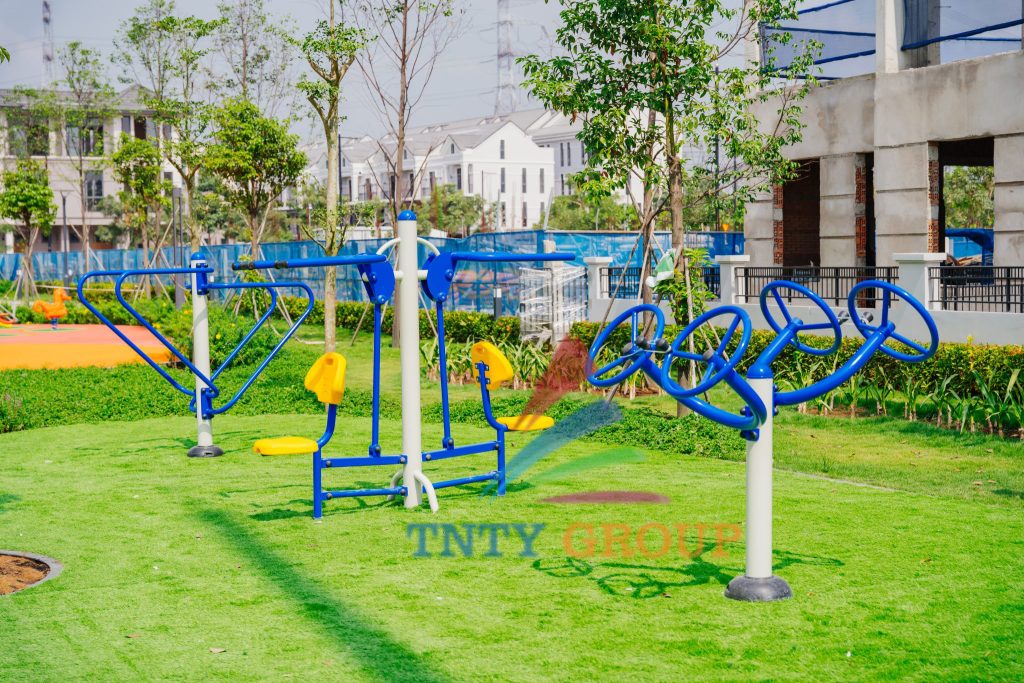
The most common design error in supposedly inclusive playgrounds is spending the whole budget on getting children up a tower. Elevated access matters, but the richest inclusive play usually happens at ground level, where a child in a wheelchair, a toddler and a teenager can be in the same activity without any transfer at all.
Strong ground level activities include:
- Sand and water play tables at reachable heights with knee clearance underneath.
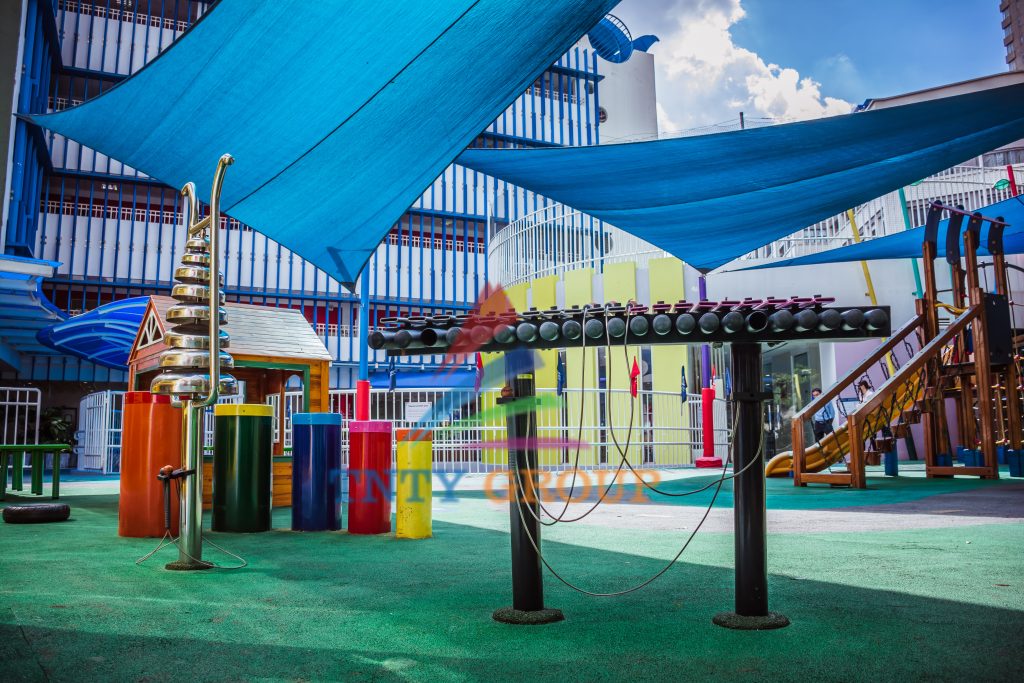
- Musical play elements: chimes, drums and tuned panels that reward any level of motor control and invite duets. Our TNTY Music range is designed for this kind of shared use.
- Ground level spinning and rocking equipment with back and side support.
- Interactive panels: gears, mazes, mirrors, sign language and tactile boards.
- Embedded trampolines and ground level surfaces flush with the accessible route.
- Roller slides and low slides with a transfer platform at the top.
- Wide ground level nets and hammocks that support a body without requiring grip strength.
- Route-based play: paths that themselves contain sound, texture and colour so the journey is play.
Height itself is not the goal. Variety of play experience is. A design that delivers climbing, swinging, spinning, sliding, sensory, imaginative and social play, each reachable by a firm route, will out-perform a tall structure with a long ramp.
Ramps and transfer systems
Where elevated play is provided, there are two ways to get onto it, and they serve different users.
| Feature | Ramped access | Transfer system |
|---|---|---|
| Who it serves | Wheelchair users remaining in their chair, plus buggies and walking-frame users | Children able to transfer out of a chair and move along a deck |
| Footprint | Large, grows quickly with deck height | Compact |
| Cost impact | Significant, both structure and surfaced area | Moderate |
| Play value of the route | High if activity panels and views are built into the ramp | Low, it is access rather than play |
| Independence delivered | Full independence for chair users | Partial, requires upper body strength or assistance |
| Best used when | Deck heights are modest and space allows a genuinely usable route | Elevated deck is a secondary offer and ground level play carries the design |
A ramp that leads to a single slide is an expensive way to deliver one experience. A ramp that passes play panels, offers a view over the park, connects two decks and ends at a choice of exits is worth the footprint. Design the ramp as destination, not as compliance.
Sensory design and the need for retreat
Inclusive design has to serve sensory processing differences, not only mobility. That means offering a deliberate spread of sensory input and, just as importantly, somewhere to escape it.
Provide a range of input
- Tactile. Contrasting textures in surfacing, timber, sand, water, textured panels and planting.
- Auditory. Tuned musical elements and water sound, positioned so they do not saturate the whole site.
- Visual. Colour contrast for low vision wayfinding, light and shadow, mirrors, and restraint in busy zones.
- Vestibular and proprioceptive. Swinging, spinning, rocking, climbing and pushing activities that regulate the nervous system.
Provide somewhere quiet
A low-stimulus retreat is the feature most often missing and most often praised once it exists. It can be a shaded nook, a small enclosure, a planted alcove with a bench, or a cocoon seat set slightly away from the main activity, with clear sightlines for a carer but visual separation from the crowd. Without it, a child who becomes overwhelmed has no option except to leave.
Zoning supports this. Place high-energy, noisy activities together and taper toward calmer zones, rather than distributing noise evenly across the site.
Universal design principles applied to play
- Equitable use. The same route and the same activities serve everyone, rather than a separate accessible version off to one side.
- Flexibility in use. Items usable in more than one way, at more than one ability level.
- Simple and intuitive. A child should understand what an item does without instruction and without reading.
- Perceptible information. Wayfinding through colour contrast, texture change and form, not text alone.
- Tolerance for error. Supportive seating, handholds, graduated challenge and appropriate impact attenuating surfacing.
- Low physical effort. Firm rolling surfaces, reachable controls, gentle gradients.
- Size and space for approach and use. Knee clearance under play tables, turning space at activities, room for a companion alongside.
Add two play-specific principles: graduated challenge, so a child can progress rather than face a binary can or cannot; and social framing, so activities put children side by side or face to face. EN 1176 and ASTM F1487 remain the safety baseline underneath all of this, and applicable TCVN requirements apply for Vietnamese public projects. Our safety standards guide explains the framework, and ADA accessibility guidance is a useful reference for accessible route thinking even outside the United States.
Specifying inclusion so it survives the budget
Inclusive features are frequently the first casualty of value engineering, usually because they were never quantified. Protect them by writing them in as performance requirements:
- State that accessible routes must reach a defined list of activities, not just the site entrance.
- Specify surfacing to satisfy both impact attenuation and accessibility of surface systems, with test evidence.
- List required play experience types, so a bidder cannot substitute two swings for a sensory zone.
- Require a low-stimulus retreat area and carer seating with sightlines.
- Require inclusive swing seat provision alongside standard bays.
- Include the accessible route and inclusive items in the maintenance regime, since a route that degrades becomes inaccessible. See our maintenance and inspection checklist.
- Understand what each requirement drives in the budget before you trade anything away, using our guide to playground cost drivers.
Frequently asked questions
Does an inclusive playground need to be bigger?
Not necessarily bigger, but it needs to be planned differently. Circulation space, turning areas and ground level activities take footprint, so an inclusive layout usually trades one tall structure for a spread of accessible activities within the same area.
Which surfacing should we use for accessible routes?
Unitary systems such as wet-pour EPDM or rubber tiles are the most reliable choice, because they stay firm and stable while still attenuating impact. Engineered wood fiber can work when installed and maintained to specification, but loose sand and gravel should not form part of an accessible route.
Is a ramp always required?
No. A ramp is one way of providing elevated access, and transfer systems are another. What matters is that the overall play offer is genuinely available to children of differing abilities, which often means investing in rich ground level play rather than a long ramp to a single slide.
What is the most overlooked inclusive feature?
A quiet, low-stimulus retreat space. It costs relatively little, takes little room, and it is often the difference between a family staying for an hour and leaving within five minutes.
Can an existing playground be made more inclusive?
Usually yes. Upgrading the surfacing on key routes, adding ground level sensory and musical elements, introducing inclusive swing seats, improving carer seating and adding shade can transform an existing site without rebuilding the main structure.
Do inclusive playgrounds require different maintenance?
The regime is the same, but the accessible route needs specific attention. Surfacing lifting, granule loss, joint curling and edge damage all remove accessibility before they become a fall hazard, so they should be logged and repaired promptly.
Design an inclusive play area with TNTY
TNTY Construction Company has designed, supplied and installed play areas, water play and safety flooring since 2017, working from Ho Chi Minh City and Solna, Sweden across public parks, airports, resorts, schools and mixed-use developments. Our team can review your site, map accessible routes, propose a balanced ground level and elevated play programme, and specify surfacing that satisfies both attenuation and accessibility requirements. Browse our product range and completed projects, and contact us to arrange a free site survey and consultation.