

 Share
ShareOutdoor Fitness Equipment for Parks: Buyer Guide
Outdoor fitness equipment has moved from novelty to standard provision in public parks, residential developments and resort landscapes. Done well, an outdoor gym is one of the highest-use assets in a park: it is free at the point of use, it serves adults and older residents who get very little else from a typical park budget, and it needs no staff. Done badly, it becomes a rusting sculpture garden that nobody uses because the equipment mix is wrong, the spacing is unsafe or the finish failed in the first tropical wet season.
TNTY Group has supplied and installed play and fitness equipment since 2017, working from Ho Chi Minh City and Solna in Sweden. We have delivered outdoor schemes across Vietnamese climates from coastal Cam Ranh and Phu Quoc to inland urban parks such as Hoa Thuan Dong Ward Park in Da Nang, and residential and resort environments including NovaWorld Phan Thiet, Dai Phuoc Lotus Zone 4 and GS Metro City. This guide covers what actually determines whether a public outdoor gym succeeds: who it is for, how the equipment is grouped, how far apart it sits, how it is protected against corrosion, and how it is maintained.
If your project also includes children’s play, read this alongside our complete guide to outdoor playground equipment in Vietnam, which covers site planning and procurement for the wider scheme.
Define the user groups before selecting a single machine
Outdoor fitness equipment fails most often because it was bought as a bundle rather than specified for a population. A park serving a dense residential district with many older residents needs something quite different from a beachfront promenade used by young adults. Four broad user groups drive the specification.
- Older adults and rehabilitation users. Priorities are joint mobility, balance, gentle range of motion and social use. Equipment should be low-impact, supported, easy to mount and dismount, and grouped so users can talk while exercising. Handrails, seats and shade matter more than load.
- General adults seeking maintenance fitness. A mixed circuit: cardio-style motion, pulling, pushing, core and stretching. These users want a route through the equipment, not a random scatter.
- Strength and calisthenics users. Pull-up and dip bars, parallel bars, monkey bars, wall bars, plyometric boxes and adjustable bench elements. This group is demanding on structural robustness and on impact surfacing beneath high bars.
- Teenagers and young adults. Often better served by a hybrid of calisthenics rigs and active play, sometimes adjacent to a ball court. This group is also the main driver of misuse loading, so specify accordingly.
The practical answer in a public park is rarely one group only. It is a zoned provision: a low-impact cluster, a general circuit, and a calisthenics rig, each with its own footprint and surfacing. Our design and delivery process begins with this user analysis during the free site survey, because it determines everything downstream.
Equipment families and what each one is really for
Body-weight and static equipment
Pull-up bars, dip stations, parallel bars, wall bars, step-up platforms, incline benches and stretching posts. No moving parts, so almost nothing to wear out or seize, very low maintenance, and highly durable. The engineering demand shifts to the anchorage and the surfacing under elevated bars.
Resistance and mechanical equipment
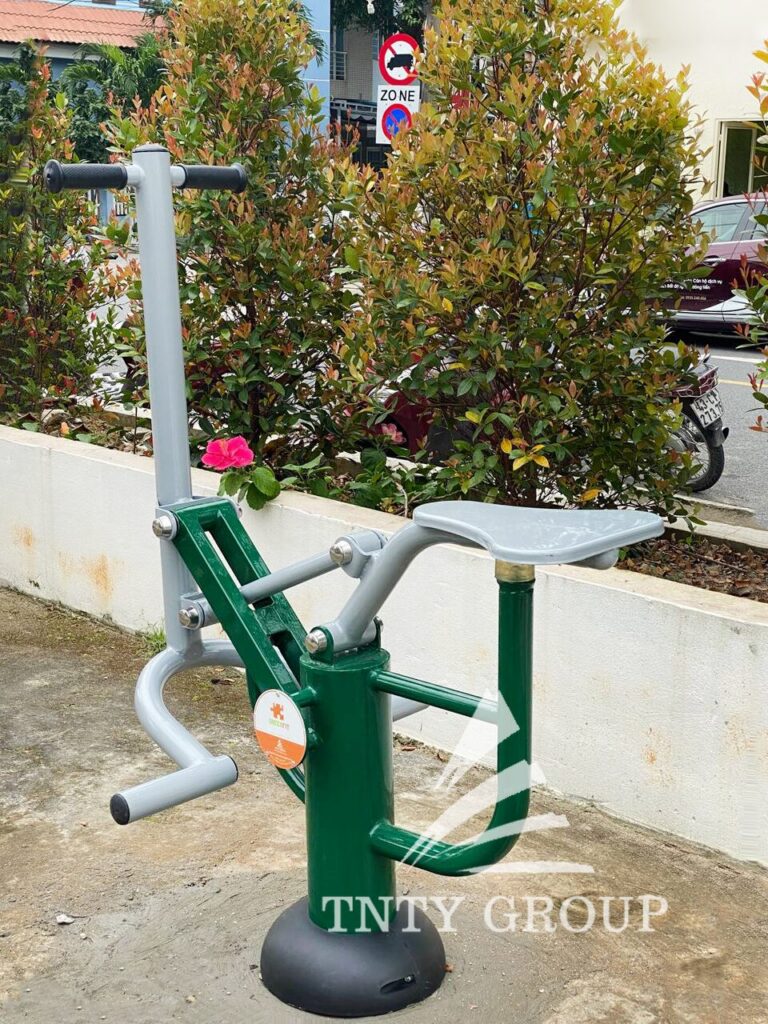
Chest press, lat pull, leg press, rowing and similar machines using either the user’s own body weight through levers or hydraulic resistance. These deliver a more familiar gym experience and are popular with general adults. They contain bearings, bushings, pivots and sometimes hydraulics, all of which are consumable items in a tropical outdoor environment. Ask for the maintenance schedule and the spare parts list before you buy.
Low-impact mobility equipment
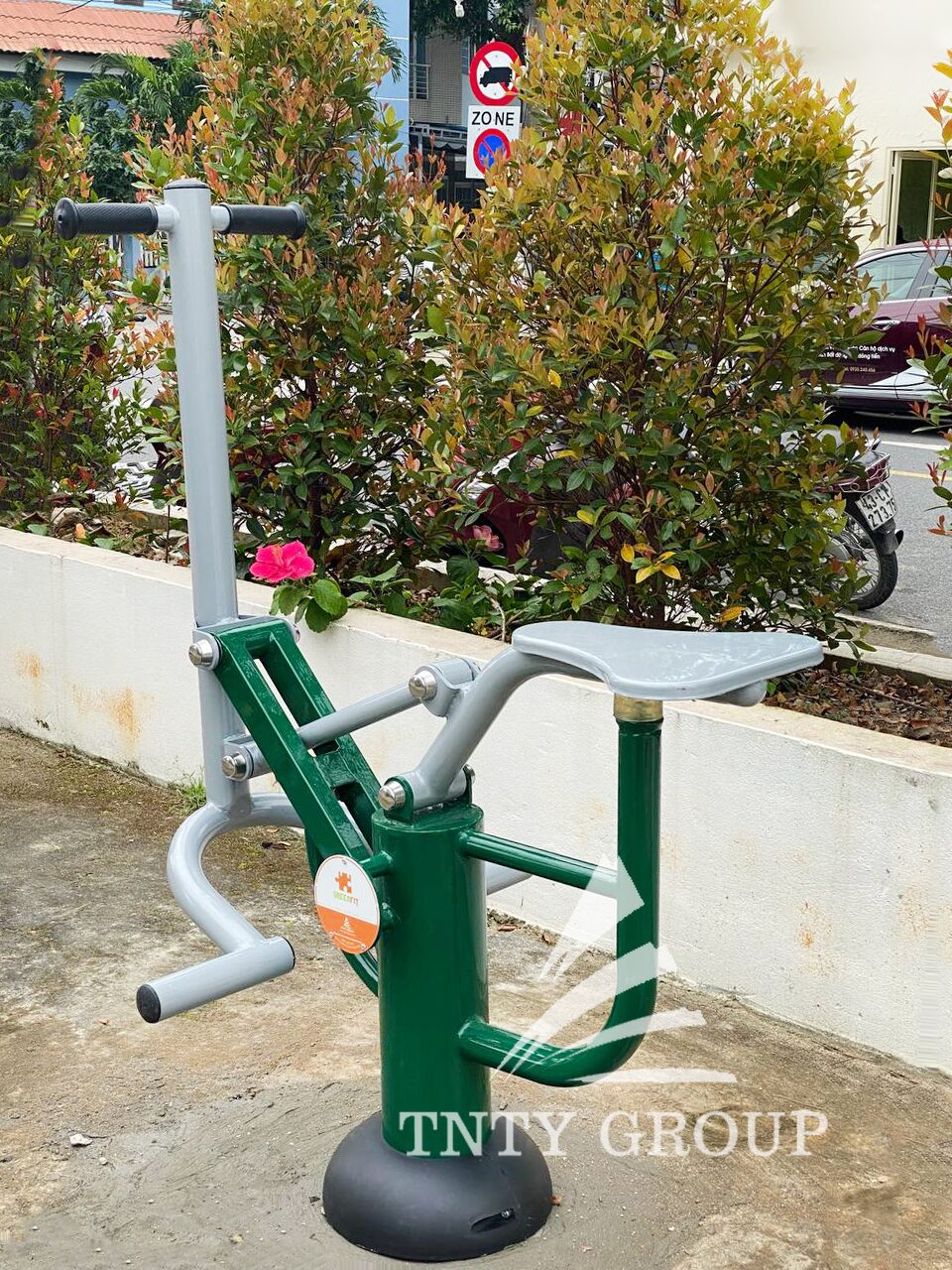
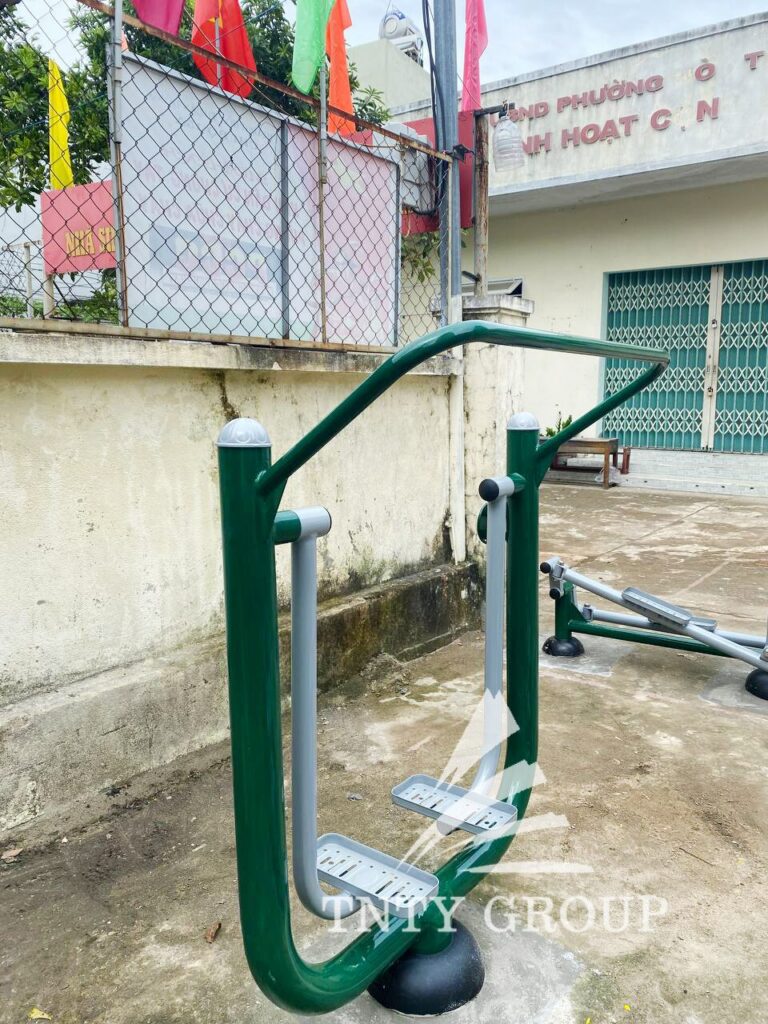
Air walkers, twisters, shoulder wheels, hand and leg cycles, balance beams and seated pedals. Cheap to install, extremely popular with older users, and the backbone of most successful municipal installations in Vietnam. Site them near seating and shade.
Human powered and interactive equipment
Equipment where user effort produces a visible output, such as lighting or sound, drives repeat engagement and turns a fitness cluster into a destination. Our Human Powered Play and TNTY Music lines fall into this category, and they work particularly well where a fitness zone adjoins a family play area.
Aquatic fitness
For resorts, hotels and aquatic centres, water-based fitness is a distinct category with its own equipment and access requirements. Our Aqua Fitness line and partner ranges such as Spectrum Aquatics address pool-side and in-pool provision. If your scheme includes water play as well, our splash pad and water playground design guide covers the hydraulic and treatment side.
The full range of families we draw on is set out in our product range and brand portfolio, which includes Green Fit, Power Systems, Everlast Climbing, Human Powered Play and UltraSite among others.
Layout, spacing and safety zones
Spacing is where most tender drawings go wrong. Suppliers publish a required use zone for each item, and it is not decoration: it is the area that must remain free of obstructions and of the use zones of incompatible neighbours. Rules we apply consistently:
- Respect the manufacturer’s use zone for every item and do not allow use zones of dynamic equipment to overlap. Static equipment can sometimes share a zone; anything that swings, rotates or has a moving mass should not.
- Keep circulation outside use zones. A footpath clipping the corner of a use zone will put a pedestrian inside the swing arc of an air walker.
- Group by intensity, not by supplier catalogue order. Low-impact items together near seating; high-intensity items together where noise and sweat are less intrusive.
- Provide a logical circuit. Users should be able to move item to item in a sensible order. Number or sign the sequence.
- Design for spectators. Benches, shade and a drinking point convert a fitness cluster into a place people stay.
- Separate from children’s play, but keep it visible. Parents exercise while children play, so adjacency with clear sightlines and a physical boundary is the ideal.
Fall protection deserves specific attention. Equipment where the user’s feet leave the ground, particularly pull-up bars, monkey bars and high calisthenics rigs, needs impact attenuating surfacing sized to the free height of fall. The test frameworks are EN 1177 in Europe and ASTM F1292 in the US, where the pass limits are HIC 1000 and g-max 200. Grass or bare soil is not a compliant surfacing solution under a high bar, and it will not stay grass under heavy use. Our playground surfacing comparison sets out the options; for wet-pour systems specifically see the EPDM rubber flooring guide.
Anti-corrosion for tropical and coastal sites
This is the single biggest technical differentiator in Vietnam, and it is where cheap equipment reveals itself within twelve to twenty-four months. Coastal sites at Cam Ranh, Phu Quoc, Phan Thiet, Da Nang and Hai Phong combine high humidity, salt-laden air, intense ultraviolet exposure and driving monsoon rain. Inland urban sites are gentler on salt but no gentler on ultraviolet and rainfall.
What to demand in the specification:
- Substrate and preparation. Hot dip galvanised steel or stainless steel for structural members in coastal exposure. The preparation regime before coating matters as much as the coating itself.
- Coating system. Polyester powder coating over a properly prepared and pretreated galvanised substrate performs far better than paint over bare steel. Ask which pretreatment is used, not just the topcoat colour.
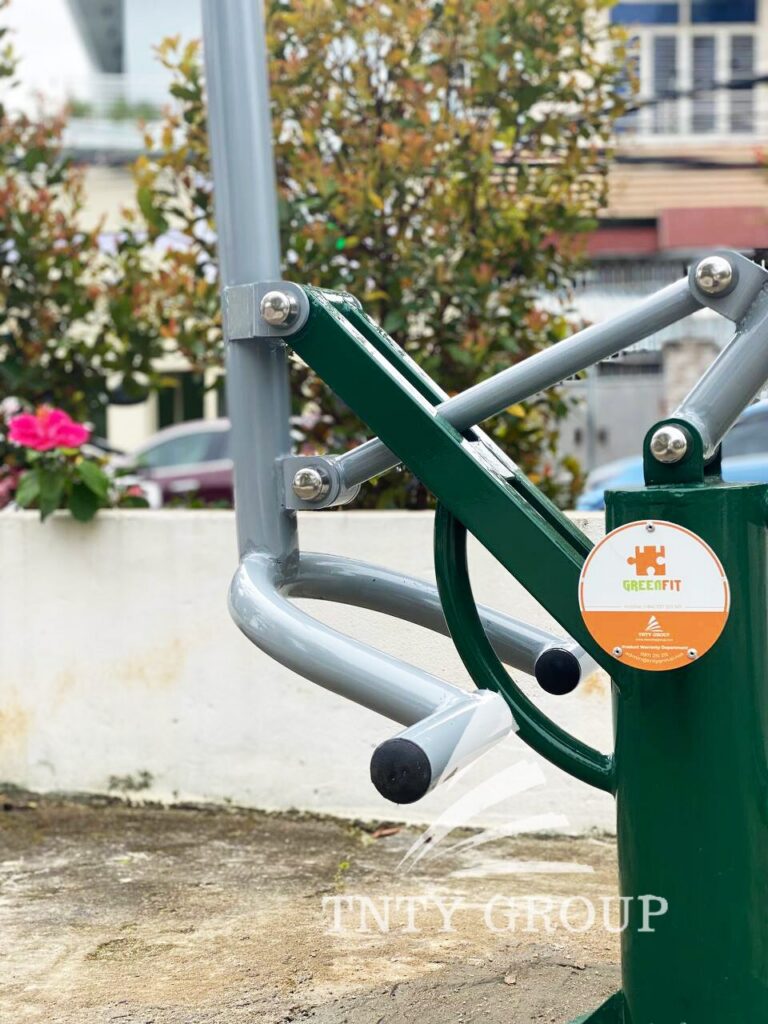
- Fasteners and small parts. Stainless fasteners throughout. A galvanised frame with plain steel bolts will bleed rust stains down the whole item.
- Dissimilar metal contact. Isolate aluminium from steel and stainless with appropriate washers or bushes to avoid galvanic corrosion.
- Bearings, bushings and hydraulics. Sealed units rated for outdoor humid service, with a defined replacement interval and available spares.
- Water shedding. No closed sections that trap water, drainage holes at the low point of every hollow member, and no detail that creates a permanently damp crevice.
- Polymer and rope components. Ultraviolet-stabilised plastics and ropes with a steel core where load-bearing. Unstabilised polymer chalks and cracks quickly in Vietnamese sun.
- Warranty scope. A warranty that explicitly addresses corrosion in coastal exposure is worth more than a longer warranty that excludes it.
| Specification item | Coastal or high-salt site | Inland urban or park site | Consequence of getting it wrong |
|---|---|---|---|
| Structural steel | Hot dip galvanised or stainless | Galvanised, powder coated | Structural corrosion, item withdrawn from service |
| Fasteners | Stainless throughout | Stainless or high-grade plated | Rust bleed, seized fixings, unsafe joints |
| Coating | Pretreated, powder coated, thicker system | Pretreated, powder coated | Blistering and undercutting within one to two years |
| Bearings and pivots | Sealed, humid-service rated, spares held | Sealed, spares available | Seizure, noise, equipment taken out of use |
| Plastics and ropes | Ultraviolet stabilised, steel-cored rope | Ultraviolet stabilised | Cracking, fading, rope failure |
| Surfacing under high bars | Bonded rubber or wet-pour to fall height | Bonded rubber, tiles or wet-pour | Head injury risk, non-compliance with EN 1177 or ASTM F1292 |
| Foundations | Deeper, drained, corrosion-protected embedment | Standard drained footing | Ponding, frost-free but waterlogged bases, loosening |
| Shade | Strongly recommended | Recommended | Low usage in daytime heat, faster material ageing |
| Inspection frequency | Shortest interval feasible | Standard interval | Defects found by users instead of by staff |
Accessibility and inclusive fitness
An outdoor gym that only serves able-bodied users is missing a large part of its catchment. Accessible provision is not expensive if it is designed in from the start. Provide a firm, stable, slip-resistant route to and around the equipment, with surfacing that meets accessibility criteria such as ASTM F1951 and the relevant ADA principles where those are referenced. Include at least some equipment usable from a seated position or from a wheelchair, with clear approach space and transfer room. Keep controls and grips within a comfortable reach range. Provide seating with backrests and armrests nearby, and signage with clear pictograms rather than dense text.
Contrast, glare and legibility matter for users with low vision, and a predictable, repetitive layout helps users with cognitive disabilities. The broader principles are set out in our article on inclusive and accessible playground design, and they apply directly to fitness zones.
Maintenance regime and lifecycle
Outdoor fitness equipment is often installed with no maintenance plan at all, which is how parks end up with half their items taped off. Adopt the same tiered inspection logic used for playgrounds under EN 1176-7, adapted for fitness items:
- Routine visual inspection. Frequent, by park staff. Vandalism, missing parts, obvious damage, litter, surfacing displacement, standing water, legibility of signage.
- Operational inspection. Periodic and more detailed. Function of every moving part, wear on bushings and cables, tightness of fixings, coating condition, corrosion at ground level and at welds, condition of surfacing at high-wear points.
- Annual main inspection. By a competent inspector, covering structural integrity, foundation condition, long-term corrosion, compliance against the original specification, and a written report with defect triage.
Alongside inspection, hold a small spare parts stock for the items most likely to fail: bushings, fasteners, grips, end caps, pivot pins and signage. The bottleneck in practice is rarely the repair itself, it is waiting for a part. Keep records: an inspection log, a defect register with dates closed, and the operation and maintenance file from handover. Our playground maintenance and inspection checklist gives the record structure in detail.
Procurement: how to write a tender that gets what you want
A fitness equipment tender that only lists item names invites the cheapest possible interpretation. Make the following explicit:
- The user groups and the required split of equipment between them.
- Named standards for equipment and for surfacing, plus applicable TCVN requirements, with documentation to be supplied for the goods actually delivered.
- Material and coating specification, including substrate, pretreatment, fastener grade and ultraviolet stabilisation.
- Use zones shown on a drawing, with a statement that no use zones overlap and no path crosses a use zone.
- Surfacing type and critical fall height for every item where the feet leave the ground.
- Foundation design and drainage.
- Spare parts list, lead times and a priced maintenance schedule for the first several years.
- Warranty terms that name corrosion, coating and moving parts separately.
- Handover deliverables: as-built drawings, operation and maintenance manuals, inspection schedule, staff training.
The wider budgeting discipline, including why lifecycle cost usually decides the true winner, is covered in playground project cost drivers. Examples of delivered schemes are in our projects.
Frequently asked questions
How much space does an outdoor fitness area need?
It is determined by the sum of the individual use zones plus circulation, not by a single figure. Take each item’s manufacturer use zone, lay them out without overlap for dynamic items, add a circulation route that does not cross any use zone, then add seating and shade. A modest cluster of eight to twelve items usually needs considerably more area than buyers first assume.
Does outdoor fitness equipment need impact attenuating surfacing?
Any item where the user’s feet leave the ground, such as pull-up bars, monkey bars and high calisthenics rigs, needs surfacing appropriate to the free height of fall, tested under EN 1177 or ASTM F1292 with pass limits of HIC 1000 and g-max 200. Low-impact seated and standing mobility equipment generally does not, though a firm, stable, well-drained surface is still required for accessibility and durability.
What is the best material for coastal installations in Vietnam?
Hot dip galvanised or stainless steel structural members, stainless fasteners throughout, a properly pretreated powder coating system, sealed bearings rated for humid service, ultraviolet-stabilised polymers and steel-cored ropes, and detailing that sheds water rather than trapping it. Salt air, humidity and ultraviolet act together, so a specification that addresses only one of them will still fail.
Should the outdoor gym be next to the children’s playground?
Adjacent with clear sightlines but physically separated is usually ideal, because it lets a parent exercise while supervising a child. What you must avoid is overlapping use zones or a shared circulation route that sends small children through the swing arc of adult equipment.
How often should an outdoor gym be inspected?
Follow the tiered model used for playgrounds: frequent routine visual checks by site staff, periodic operational inspections covering moving parts and fixings, and an annual main inspection by a competent inspector with a written report. Coastal and high-use sites should sit at the short end of every interval.
Can outdoor fitness equipment serve older residents safely?
Yes, and it is often the highest-value use. Choose low-impact, supported, easy-access equipment, keep transfer heights low, provide handrails, place the cluster near shaded seating and a firm accessible route, and use clear pictogram signage. Grouping the equipment so users can socialise while exercising markedly increases repeat use.
Book a free site survey
Specifying outdoor fitness equipment well is mostly about matching the equipment mix to real users, laying out use zones honestly and protecting metalwork against the actual climate of the site. TNTY Group offers a free site survey and consultation across Vietnam: we will assess exposure conditions, propose a zoned equipment mix, set surfacing and fall heights against named standards, and give you a maintenance regime you can actually resource. Get in touch through our contact page, call the Ho Chi Minh City office on 84 28 66 89 8888 or the hotline on 84 937 501 501, or reach our Solna office in Sweden on 46 842 002 688. You can also read more about us and how we work.